
Understanding Interoperability in AMRs: The Key to Scalable Warehouses
Discover how interoperability acts as the universal language for AMRs, allowing multi-vendor fleets to collaborate. Learn how standards like VDA 5050 drive seam..
Discover how interoperability acts as the universal language for AMRs, allowing multi-vendor fleets to collaborate. Learn how standards like VDA 5050 drive seamless, scalable warehouse automation across different brands.
Interoperability. This is a term that is mentioned very frequently in the world of warehouse automation. But what does it exactly mean for AMRs and warehouses? Why is there a need for interoperability in the first place? How is it implemented? What does it mean for the future of warehouse automation? In this blog, let us explore the answers to some of the most commonly asked questions about interoperability and ultimately about ANSCER implements interoperability in its robots
Table of Contents
What Goes Wrong Without Interoperability?
How does Interoperability actually work?
Choosing the right interoperability standard
Long-Term Benefits of Interoperability
How ANSCER Enables Interoperability
Reasons why ANSCER chose VDA 5050
Conclusion: Building the Foundation for Scalable Automation
What is interoperability?
In the context of warehouse automation, interoperability is a set of standards that allows AMRs and fleet managers from different vendors to seamlessly communicate and act in a coordinated manner.
Why interoperability matters?
When material handling automation began, the use of a single vendor robot meant that the cost of automation was less, the implementation was smooth, and servicing was simple. However, warehouses began to employ robots from more than one vendor based on their suitability for their applications.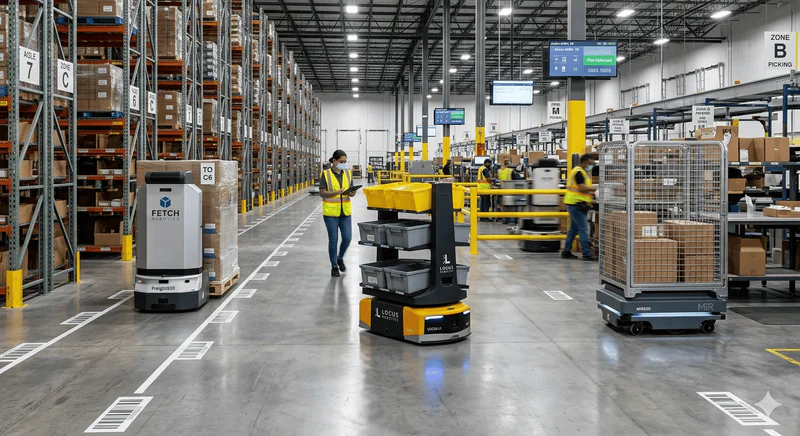
This led to disconnected systems, lack of coordination, and delays needing manual intervention. To address these issues, in 2021, the MassRobotics Interoperability Standard 1.0 was introduced. This was the first interoperability standard to be introduced, driven by customer demand to avoid vendor lock-in. It enabled robots of different vendors to communicate, navigate, and share status data. This standard laid the groundwork for broader adoption alongside standards introduced later like Open RMF and VDA 5050.
What Goes Wrong Without Interoperability ?
Without interoperability, each system operates in isolation, leading to the following issues.
Disconnected Systems
Robots and systems operate in isolation, preventing seamless coordination across operations.
No Common Language
Different data formats and communication methods require custom integrations, increasing cost and deployment time.
Broken Workflows
Tasks are not automatically triggered across systems, leading to delays, idle time, and manual intervention.
Lack of Coordination
Robots cannot share intent or status, resulting in congestion, conflicts, and inefficient routing.
Limited Visibility
Inconsistent data reporting makes it difficult to monitor performance and optimize operations.
Poor Scalability & Vendor Lock-in
Adding new vendors requires re-integration, slowing expansion and reducing flexibility.
In today’s increasingly automated and multi-vendor environments, interoperability is no longer optional, it is the need of the hour. Let us now understand how interoperability is implemented in real-world AMR systems.
How does Interoperability actually work ?
It would be natural to assume that interoperability is one universal standard that can address all the issues caused by multi-vendor fleet operation. But the reality is much more complex than this. Expecting one universal protocol to govern fleet control, cross-fleet coordination, infrastructure access, analytics integration, and hardware-level behavior would either oversimplify critical industrial requirements or result in an unmanageably complex specification.

Therefore, interoperability in AMRs is implemented through a layered technology stack that enables seamless communication and coordination across systems. This includes standardized communication formats, middleware like ROS, data exchange protocols such as MQTT, fleet orchestration systems, and API-based integration with enterprise software.
Layers of interoperability
To implement interoperability, the industry has developed a set of specialized standards. Each standard addresses a specific aspect of enabling robots to work together.
VDA 5050 - Fleet Level command Control
VDA 5050 defines a standard interface by which a fleet management system communicates with robots.
MassRobotics Standard – For Monitoring & Data sharing
MassRobotics standard defines how operational data such as position, battery state, health metrics, availability, is published for external consumption.
OpenRMF - For Coordination and Shared Infrastructure
OpenRMF manages how multiple fleets negotiate shared resources. It is responsible for conflict resolution and infrastructure sharing.
Choosing the right interoperability standard
Implementing interoperability in a facility depends on the nature of the usecase in that facility. It is like choosing the right screwdriver based on the type of screw that it is to be used for. Before choosing an interoperability standard or a combination of interoperability, it is important to identify what aspect of multi-fleet operation needs to be addressed such as:
Based on this, we can decide which standard is to be applied for which usecase.
VDA 5050 – For Command & Control
In environments like automotive plants or structured warehouses, where robots from different vendors must execute tasks in a coordinated sequence, VDA 5050 is ideal. It enables a central system to assign and manage tasks across fleets using a standardized format, ensuring seamless workflow execution without custom integrations.
MassRobotics Standard – For Visibility & Monitoring
In facilities such as hospitals or large campuses with multiple independent robot fleets, the MassRobotics AMR Interoperability Standard is best suited for providing a unified view. It allows operators to monitor robot location, status, and performance across vendors without needing centralized control.
Open RMF – For Coordination & Shared Infrastructure
In complex environments like airports or smart buildings where robots share resources such as elevators, corridors, and doors, Open RMF enables smooth coordination. It manages traffic, prevents conflicts, and ensures efficient movement across multiple robot fleets.
Long-Term Benefits of Interoperability
Long-term interoperability in Autonomous Mobile Robots (AMRs) provides sustained operational efficiency, allowing heterogeneous fleets from different vendors to work together. The key long-term benefits of interoperability include:
How ANSCER Enables Interoperability
Out of all the current interoperability standards available, ANSCER Robotics adopts the VDA 5050 standard for its robots. All ANSCER robots are compliant with VDA 5050 version 2.0.0. So what does this mean in a real-world scenario? It means that any ANSCER robot can be controlled by a third party fleet management software that is VDA 5050 version 2.0.0 compliant. Given below is a simple flow of interoperability as implemented by ANSCER.
Reasons why ANSCER chose VDA 5050
In real-world deployments, different robot manufacturers use their own methods for task assignment, status reporting, and navigation. VDA 5050 addresses this challenge by defining a common language and structure for communication.
It standardizes how tasks are assigned, how robots report their status and progress, and how positions, routes, and actions are defined. By doing so, it allows different robots and systems to work together seamlessly without requiring custom integrations.
More importantly, VDA 5050 does not control robot behavior or optimize operations. Instead, it ensures that communication is consistent and predictable, forming the foundation for true interoperability. A demo of an ANSCER robot being controlled by third party fleet management software can be seen in the video below.
Conclusion: Building the Foundation for Scalable Automation
As warehouses evolve into complex, multi-robot environments, interoperability is no longer optional, it is essential. The ability for different systems to work together seamlessly determines not just operational efficiency, but also how easily businesses can scale, adapt, and innovate.
By enabling interoperability, solutions like ANSCER Fleet empower businesses to move beyond vendor limitations, adopt best-fit technologies, and future-proof their automation strategies. Ultimately, it is not just about deploying robots; it is about building a connected ecosystem that works as one.
This is the lead-generation form
Get info from your blog visitors for lead funnel
ANSCER Robotics
Automate factory material movement with modular AMRs, pallet stackers, and fleet software. Boost throughput and cut labor costs. Book a demo.
Visit Site